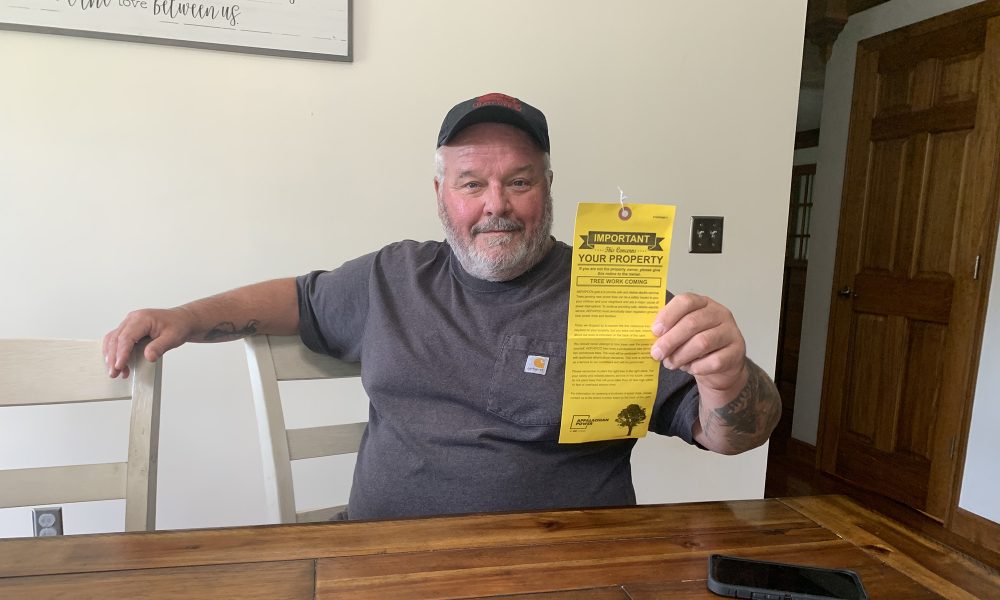



Bill Hatcher displays a notice informing him that unnamed contractors will be visiting his property at an unannounced hour at some future time.
The news that Appalachian Power’s rebuild of the Bancroft-Milton transmission line would not affect the Meeks Mountain Trails was good news to the ears of many. It was good news to many because many had donated endless hours to build the 30-plus miles of trails. The many would not see their investment of time and labor erased.
Bill Hatcher was not one the many. The new transmission line route will bisect a bit more than 20 acres of Hatcher’s property. The easement which will allow Appalachian to construct the line on the property includes ingress and egress rights. For a land owner, an easement means a permanent loss of land use. Hatcher has firsthand experience with Appalachian easement rights because a 765-kv line easement separates the affected 20-plus acres from acreage upon which he has raised cattle for more than thirty years. The experience has been unpleasant and resulted in financial losses for which Hatcher received no compensation.
Hatcher fears that the new transmission line and easement will be far more unpleasant. “I cannot build on the land; I lose the timber; I cannot graze cattle on it. A contractor, clearing the right of way, destroyed the grass beneath the existing line. That was this summer. If the company had waited until fall, the loss would have been small,” Hatcher said. In previous years, grazing has been impossible because of herbicide use.
Following the derecho of 2012, the company sent in contractors who cut the timber in a deep hollow below the transmission line. The timber, unlike trees growing near the lines, was not affected by the pulsating fields produced by high voltage. Hatcher did not discover the fallen timber until days after the deed. The timber was lost. Appalachian refused to listen to his complaint, stating that he needed to talk to the contractor.
Appalachian’s use of contractors should require the company to be responsible for losses. Appalachian has refused to compensate Hatcher for past contractor-caused damage incurred to a farm road and to a farm pond while making ingress to the right-of-way.
A helicopter trimming operation of the line resulted in a heavy limb falling upon a cow. The blow injured the cow, causing her to abort on the spot. The injury ended the cow’s calf-producing years.
Hatcher believes that Appalachian should be required to do that which is right and fair. “Easements are not right and fair. I cannot use the land but must pay the taxes on it. A power line right-of-way is an open invitation to unauthorized 4-wheelers. Easements exempt Appalachian from liability. The land owner is not exempt. Being right and fair would require Appalachian to buy the acreage which I cannot use. If they own the land, they own the liability and must pay the taxes,” Hatcher stated.
Hatcher fears that loss of the land use will eventually force him to abandon farming. Active farms enjoy a tax break. His taxes would virtually double overnight if he were to shutdown his cattle operation.
Hatcher has thirty years of time and labor invested — thirty years which may be destroyed by an easement.


