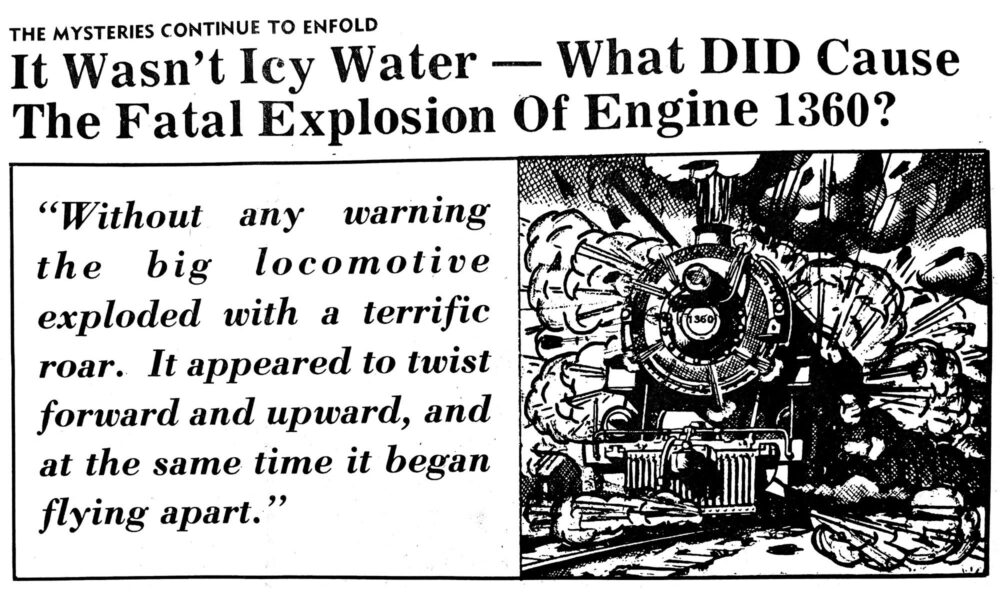


This drawing, “The End of the Line for Old 1360,” is by W.D. Wintz. Engine 1360 met its spectacular and fatal end in Hurricane on January 9, 1926. The real cause of the fiery, tragic accident has never been determined.
Editor’s Note: The Breeze is reprinting the following article in remembrance of the day in which C&O Engine No. 1360 blew up in the the middle of Hurricane.
By William D. Wintz
(Re-printed from the Upper Vandalia History Society, 1972)
Saturday, January 9, 1926, had been a cold, snowy day in Putnam County’s town of Hurricane. It was nearly 5:30 pm, and some of the merchants along Main Street were already closing their stores. Most of the Saturday farm trade had left town and only a few people were on the street.
The happy sounds of children sleigh riding off the railroad over-pass was drowned out by the noise of the giant Mallet engine passing underneath. It was just topping the grade leading into town, pulling a long freight loaded with coal.
Down at the other end of the railroad cut that paralleled Main Street several people had begun to gather at the depot. They were awaiting the arrival of No. 13, the passenger train that brought the evening mail. Warner Leake, the off-duty station agent, was standing on the platform as the big engine slowly approached the water tower.
Just about then the whole town seemed to rock. Without any warning the big locomotive exploded with a terrific roar. It appeared to twist forward and upward, and at the same time it began flying apart. Then in a cloud of black smoke, steam and burning coals the remains fell across the tracks like a stricken monster.
Young Tony Allen, Irene Forth and her brother Norman and Louis, Rachael and Raymond Qualls forgot about sleigh riding for the rest of the day. They had looked up just in time to see the eruption of black smoke and steam mushrooming in the sky.
Mrs. B.D. Taylor and her small son Jay were walking along the sidewalk directly above the exploding engine and had no chance to protect themselves. Both were knocked down and were dangerously injured by flying fragments of coal, rock and steel.
The railroad right of way through the business section is about 20 feet below the level of the street. This, together with the fact that many of the stores had been closed for the day, while the occupants of others were at the rear of the buildings, is believed to have saved many lives.
E.I. Ford, assistant to the general superintendent of the road here, was quoted as saying, “An investigation of the explosion would be made within the next few days, and that until then no statement as to the cause of the disaster would be made.”
The Charleston Daily Mail carried this follow-up article on January 11, 1926:
“THIRD MAN HURT IN EXPLOSION AT HURRICANE DIES”
Burns Received When Locomotive Blew Up Prove Fatal to Fireman Chattin
MUCH DAMAGE DONE IN TOWN
Two Truckloads of Glass Sent From Charleston to Repair Smashed Store Windows
A third name was added to the list of dead in the locomotive explosion that occurred in Hurricane Saturday evening when Charles E. Chattin, fireman, died of scalds and burns in the Chesapeake and Ohio Hospital in Huntington at 8 o’clock yesterday morning. Jeff D. Rose, engineer, and E.P. Henry, brakeman, were killed instantly.
BUILDINGS DAMAGED
The damage from the terrific blast was more wide-spread than first reports indicated, and citizens of the town are surprised now that more persons were not injured by flying fragments of the giant Mallet-type engine. Mrs. B.D. Taylor of the village was seriously hurt when a piece of metal struck her on the jaw. She was walking along the main street of the town overlooking the tracks which lie in a cut at that point.
A chunk of iron weighing several hundred pounds was hurled nearly 100 yards and crashed the corner off a two-story building owned by Cline McCallister and occupied by a Farmer’s Hardware Company. A small piece of metal tore a large hole in the side of a business building owned by C.F. Leadman and standing 200 or more yards from the scene of the explosion.
So many windows were shattered that two truckloads of glass were sent form here. The total damage was estimated from $15,000 to $20,000.
HAD NARROW ESCAPES
Among those who narrowly escaped death or serious injury was Leroy Burton, clerk at G.P. Foster’s general store. A shower of metal slugs, some weighing several pounds, crashed through the windows and sides of the building and fell on him. He was unharmed.
Windows and showcases in A.N. Sumner’s store were shattered. A big window in the building occupied by the Hurricane Breeze was smashed in. Just a few minutes before R.F. Forth, publisher, and a couple of employees had been conversing inside the building and looking out this window.
Young Ben Kiff had been to the store for his mother and was on his way home. He had just turned the corner of Main Street when the blast occurred.
Ducking back around the corner, he was in time to see parts of the engine flying through the air. Ben also recalled that when the air had cleared, the snow had turned completely black for at least 100 yards in all directions.
Bob Forth, editor of the Hurricane Breeze, had just been looking out the front plate-glass window of his new building. Hardly had he turned to walk away when the glass from the window blew out all around him. He considered himself lucky not being cut, although he had to spend the rest of the night cleaning up the front of his new office.
The following account of the tragedy was carried in the Sunday Morning Charleston Gazette, January 10, 1026:
TWO ARE KILLED, THREE ARE HURT IN TRAIN BLAST
Boiler of C&O Locomotive Blows Up While Passing Through Hurricane
Engineer and Brakeman Die
Entire Town is Rocked by Blast
Store Fronts and Windows in Buildings Nearly Wrecked
Flying Steel Injures Woman and Boy Who Were Passing
Huntington, January 9 — Two men were killed and another seriously injured and at least two persons suffered minor injuries when the boiler of a giant Mallet engine of westbound Chesapeake and Ohio Freight train 1360 exploded directly in front of the main business section of Hurricane, West Virginia, at 5:30 o’clock in the afternoon. The dead: Jeff D. Rose, engineer of Huntington; and E.P. Henry, brakeman of Russell, Kentucky. The injured: Charles E. Chattin, fireman, of Russell, Kentucky, probably fatally burned by steam, (died at short time later); Mrs. B.D. Taylor of Hurricane and her small son painfully burned by a piece of flying steel.
The entire town, which is about midway on the Atlantic-Pacific highway between here and Charleston, was rocked by the terrific explosion, which completely demolished the big engine and threw the coal and water tender about 15 feet away, overturning it.
Store fronts and windows in the business houses fronting on the street, which parallels the Chesapeake and Ohio right of way, and virtually adjoins it, were wrecked; the occupants in many instances being thrown down and furniture and store fixtures tumbled about by the force of the blast.
Tonight Hurricane’s lighting system was badly crippled, many poles and wires near the C and O tracks being torn down, and residents had many weird versions of the tragedy to relate.
BLAST COMES SUDDENLY
The engine, one of the newest types of the Mallet locomotives, was at the head of a long string of loaded coal cars and had stopped at Hurricane to take on water. The explosion came without warning and while no definite announcement as to the cause has been made at the local offices of the railroad, it is believed the pouring of the icy water into the boiler was responsible. (AUTHOR’S NOTE: This statement later proved to be incorrect as investigation revealed the train had not stopped nor had it taken on any water.)
Fireman Chattin’s body was taken to Hinton today on Train No. 6. That was his old home; but for some time he had lived in Ironton. He was 27 years old; he is survived by his widow and had worked for the railway company more than nine years.
Engineer Rose, 31 lived at 308 West Ninth Street, Huntington. He had been with the railroad since 1908. He is survived by his widow and several children.
Brakeman Henry, 28, was also married and lived at Russell, Kentucky. He had been in the employ of the C&O since October, 1920.
INVESTIGATION BEGUN
Huntington, January 11 — An investigation was underway by Chesapeake and Ohio railway officials today to determine the cause of the explosion of a Mallet-type locomotive at Hurricane late Saturday which claimed its third victim yesterday when C.E. Chattin, fireman, died in the railway hospital here. Engineer Jeff D. Rose and brakeman E.P. Henry were killed almost instantly.
Chattin was badly scalded and little hope had been held for his recovery. All of the men were married.
Casual investigations of the wreckage by newspapermen yesterday revealed that the main force of the blast struck downward, a factor which is believed to have held down the casualty list.
The total damage to Hurricane’s business section will amount to at least $20,000, insurance men have estimated.
Although it was 69 years ago when the engine blew up, anyone you talk with today who was in Hurricane that fateful evening can vividly recall their own personal recollections of the disaster.
Doris Sovine, a bride of only 10 days, was in Sumner’s store waiting for her husband, A.E. “Preacher” Sovine. He was working in St. Albans for the railroad and he was due to come home by train almost any time.
He had planned to try to catch a ride on a freight if one stopped in St. Albans for water. After the explosion occurred, Mr. Sovine found herself in the rear of the store surrounded by ballast rock and broken glass, but she was uninjured.
When Doris realized what had happened, she naturally feared her husband might have been in the engine. As soon as she learned that the victims were at the Kerns house, she immediately went to check. Although she was relieved not to find her husband, she never forgot the terrible scene.
Irene Ramsey (later Mrs. Warner Leake) was working in Huntington when she first heard the news from paper boys selling extras on the street. All she heard was “Read all about the explosion in Hurricane.” Not waiting to learn the details, she quickly caught a taxi and rushed home to make sure if her parents were safe.
The force of the blast knocked out the electric power in town, and at least one fire was started by a broken gas light mantle.
One of the victims was blown into the front yard of the Kerns home next to the former site of the Hurricane Woman’s Club. Another was left suspended and entangled in the telegraph and power lines between the street and the railroad.
Helen Jordan (later the wife of Judge Dennis Knapp) lived about 200 yards from the scene of the explosion. She recalls that she and her sister Frances had been sleigh riding in the immediate area and had gone in the house only minutes before. Her father was T.A. Jordan, who was also the company doctor for the C&O Railroad in Hurricane.
Mrs. Knapp remembers that the smoke stack off the engine hit the side of the building next to her house and bounced back in their front yard, making a terrific noise. She said she afterwards followed her father up to the Kerns house and saw the bodies of the victims and it left a lasting impression on her young mind.
She also recalled that some of the school children later put together a ballad that they called “The Wreck of Old 1360.” She did not believe that the words or tune was ever recorded because it never drew much attention from the adults.
There is still a mystery concerning the round brass plate that was engraved with the engine’s number 1360. It was mounted on the front of the locomotive in the center of the boiler plate, and it probably was thrown a great distance from the scene.
Even though railroad officials and many civilians have looked for the disc, there is no record of it ever being found. Several rumors persist, however, concerning who might possibly have the long-lost momento in their possession.
The cause of the explosion has been argued pro and con by old railroaders down through the years. Some say that Jeff Rose was a “low water engineer.” In railroad jargon this meant that he ran with a low water gauge which provided more steam pressure in the boiler.
Others blamed an anti-foam additive that was mixed with the water. They contended this chemical stained the gauge glasses and made it difficult to determine the water level. Investigation also disclosed that the safety soft plugs in the boiler were still intact and had never blown.
And that is how it was when tragedy stuck in Hurricane, West Virginia, that Saturday evening, January 9, 1926. The day the engine blew up will never be forgotten by those who were there.


