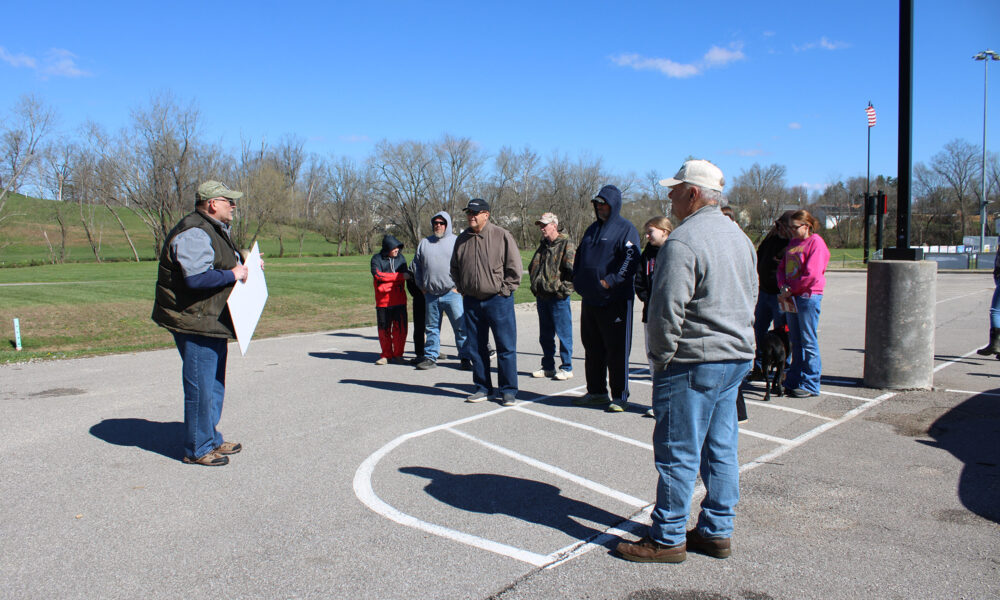
Those interested in local history gathered at the parking lot of Hurricane Bridge Park for the first part of a traveling lecture about the 1863 battle.
In the wee hours of the morning of March 28, 1863, Captain James Johnson, the Union commander of a fort which had been built on the heights above the small village of Hurricane Bridge, was delivered surrender terms by a group of Confederates under the command of General Albert Gallatin Jenkins. When the captain refused to surrender, the Confederates retaliated by firing down upon the fort from the nearby hills. The conflict lasted for five hours before the Confederates finally gave up and withdrew, burning several homes in the nearby village in their wake.
This past Saturday, March 28, local historian Dr. Philip Hatfield hosted a tour of the battlefield to commemorate the 163rd anniversary of the Battle of Hurricane Bridge. Accompanying him were reenactors from the 13th West Virginia Infantry, a local reenacting group depicting the same Union regiment which was stationed at Hurricane Bridge.
Dr. Hatfield states that there are a lot of historical misconceptions concerning the Battle of Hurricane Bridge, which has traditionally been classified as a skirmish rather than a battle. A lot of local history books which were published in the 1980’s and 90’s use family or oral histories as primary sources, and over time, accounts of the past get simplified or forgotten entirely. One woman who participated in the tour said that she had always heard that the conflict at Hurricane Bridge resulted in no casualties, and she was amazed to discover that this was not true.
The tour began in the parking lot of Bridge Park on the Midland Trail side, where Dr. Hatfield discussed the history of the village which had once stood there in the mid-19th Century. A Union fort had been constructed on the heights above the village to monitor the James River and Kanawha Turnpike, but the earthen fort was only partially finished, and thyroid and pneumonia ran rampant in the camp due to poor sanitary conditions. Many of the soldiers at the fort had no prior fighting experience, and the Battle of Hurricane Bridge would be the first conflict that they endured.
The next location on the tour was the Kelley’s Cove subdivision, where Dr. Hatfield directed people to a dead-end street located at the highest point of the gently rolling hill. This was the location of the Union fort, a place which had been chosen for its commanding view of the surrounding land. However, the Confederate forces positioned themselves on the ridges to the northwest and southeast, which have a much higher elevation than the land upon which the fort had been built. Approximately 270 Union soldiers and 600 Confederates fired back and forth for five solid hours, until at last the Confederates withdrew. According to Dr. Hatfield, the Union forces suffered at least ten casualties, three of which were fatalities. The Confederates lost two or three men, with an unknown number of wounded.
The last location on the tour was the parking lot of ShotFire Fitness, located on Midland Trail. The high ridge above the gym was one of the locations where the Confederates fired down upon the Union fort. After the Confederate forces withdrew, some of the soldiers went into the village of Hurricane Bridge and burned several homes.
“The Civil War in West Virginia was personal, malevolent, and vicious,” said Dr. Hatfield.
At the end of the tour, participants had an opportunity to purchase signed copies of Dr. Hatfield’s book, “The Battle of Hurricane Bridge.” Twenty-five percent of the proceeds from book sales are donated to Hurricane youth sports.

